
Gordon County Most Wanted Basics
The sheriff's office posts each notice individually in its photo-based Most Wanted category, with a separate Captured section alongside it. Treat these as public-safety notices. They are not a warrant database. They are not a live jail roster or a court file either. There is no dependable count and no fixed posting schedule. So never assume every active warrant shows up, or that a post gets updated on a set cycle.
A typical listing identifies someone law enforcement wants to find. It may include a photograph, a charge, and physical details. Photos stay on the official page. That is the right place to view a current post, not secondhand copies floating around.
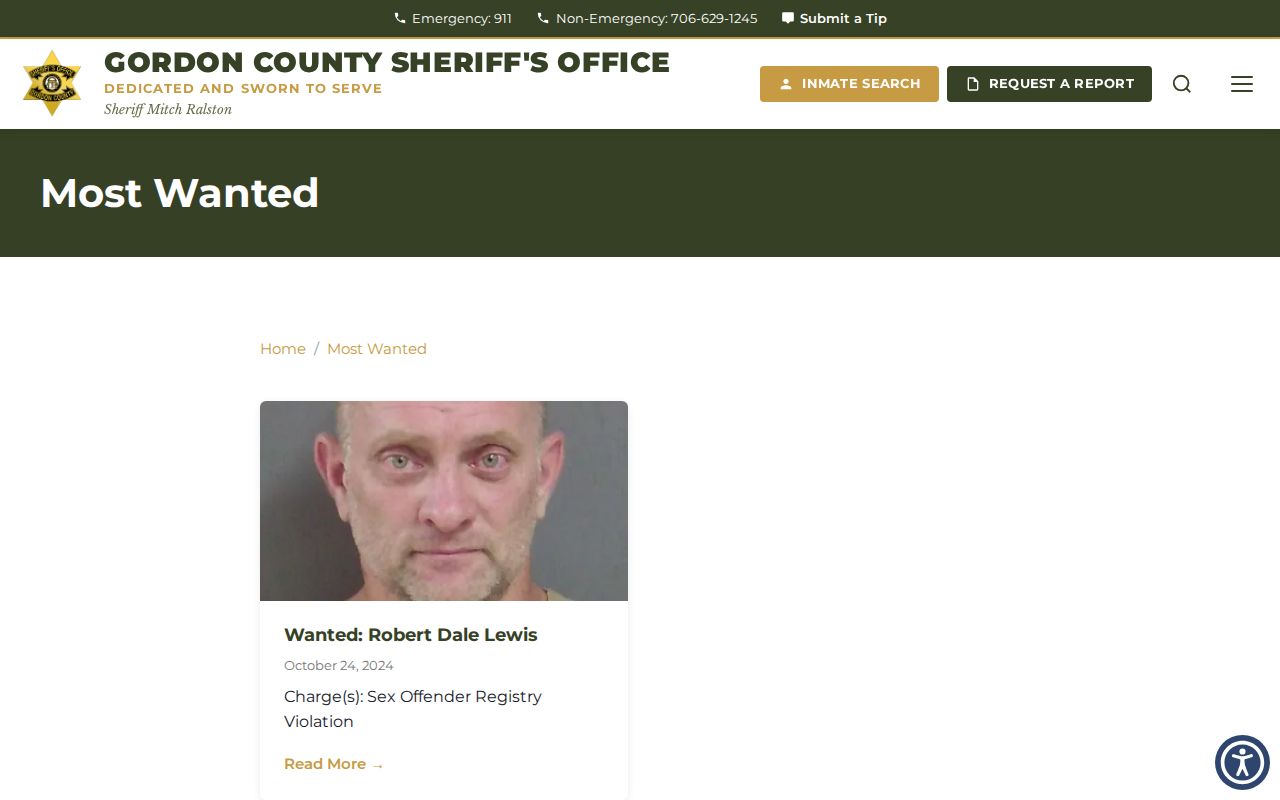
The page changes over time. Read the current notice directly from the sheriff's site, and verify later status with the originating office or the court before acting on anything.
Gordon Wanted Listing Fields
Each post can carry several identity fields. Think name, alias, birth year, physical description, charge, and last-known location. Not every post carries every field. Read what is there rather than expecting a fixed template. Every detail comes from the sheriff for identification and public notice. Treat a location as a last-known address, not as proof of where the person is now.
| Field | What it may show |
|---|---|
| Photo | An identification image displayed on the official wanted post. |
| Alleged charge | The charge or warrant basis as described by the sheriff, not a conviction. |
| Last-known address | A location associated with the notice, not proof that the person is there now. |
| Physical description | Race or sex, height, weight, hair, and eyes where provided. |
| Identity details | Birth year, alias, name, or other details used to distinguish people. |
| Comments | Additional law-enforcement notes that still require official verification. |
Watch out for similar names. Before sharing anything, compare the alias, birth year, physical description, and the exact wording of the post. Let the sheriff's office and the clerk of court confirm the notice and any outcome.
How to Read Gordon Wanted Posts
Think of the list as a public-information notice. It is not an invitation to investigate someone yourself. Keep three questions separate in your mind: what the charge says, whether the person is still wanted, and whether anyone is actually in custody.
- Open the current official Most Wanted category and select the individual post. Note the post title and any date shown, without assuming that the date is the date of the alleged event.
- Read the alleged charge and descriptive fields exactly as written. Do not turn a listed charge into a statement that the person committed a crime.
- Compare the name with the alias, birth year, physical description, and other identifiers. Similar names do not establish identity.
- If you recognize someone or know relevant information, keep your distance and send it to law enforcement through the confidential tip route. Do not approach, follow, arrest, or detain the person.
- Check the separate Captured category only as a sheriff status signal. It is not a court disposition and does not by itself answer whether the person is now held in the Gordon County Jail.
A post can still be useful for a tip even when the person is not in the county jail. Someone on the list may be elsewhere in the state. Another agency may have made the arrest. Or the online status may simply lag behind events. To check whether a particular person is in Gordon custody, use the county booking and roster search and read its custody window carefully.
Gordon County Captured Status
The Captured category means a wanted post has moved into a different status maintained by the sheriff. That is all it says. It does not explain how the person was located. It does not say where they are held or what a court decided afterward. Like the main list, the category publishes no reliable count and follows no set schedule.
Statuses vary more than the labels suggest. A person can be listed, captured, released, transferred, or waiting on a court date. Keep those states distinct rather than collapsing them into one word. The official tip page accepts anonymous information. It promises no reward, though.
Gordon County Tip and Safety Rules
The official GCSO tip page lists a confidential, 24-hour line and confirms that anonymous tips are welcome. Wanted-person information is one of its named uses. The channel exists so you can pass information to law enforcement, not so you can make an arrest yourself. An active crime or emergency belongs with 911. General questions that are not emergencies belong with the sheriff's non-emergency line.
Confidential tips
706-879-5515
Available 24 hours. Anonymous tips are accepted.
Emergency
911
Use for an active crime or emergency.
Non-emergency
706-629-1245
Use for general sheriff or county warrant questions.
No reward is offered. Do not promise payment to anyone, and never ask a neighbor to confront a person on the list. Share the tip instead of the photo. A good tip helps the sheriff without you needing to prove anything at all.
The emergency distinction is spelled out clearly. The official tip route carries a standing warning that emergencies belong with 911, not with the tip form.
Contact details can change. Confirm current instructions directly with the sheriff's office, and keep your own safety ahead of curiosity every time.
Checking a Gordon County Warrant
Gordon County has no public warrant-query portal. The safe check starts with the sheriff and the relevant court, never with a wanted list or a third-party site. County requirements vary. Showing up in person with an outstanding warrant could end in custody. If the warrant is yours, let a lawyer or the court point the way forward.
Call the Gordon County Sheriff's Office at 706-629-1245 to ask how warrant information can be verified. The clerk of court can confirm a filed case. A preliminary calendar is not a final outcome, though. A wanted notice alone cannot answer every question about an active warrant or current custody.
Gordon County Warrant Types
Gordon County publishes no warrant list sorted by type. Its wanted page uses broad status labels instead. The sheriff's office sets those labels. Call the GCSO or a clerk about a name, though, and you may hear legal terms like the ones in the table below. Use the table as a cheat sheet for that conversation. It clarifies labels. It does not mean every legal category shows up on the wanted page itself.
| Warrant-related label | Gordon County verification path |
|---|---|
| Arrest warrant | Ask GCSO whether county warrant information can be confirmed. No public all-warrants portal was located. |
| Bench or court warrant | Ask the relevant clerk or court to identify the case and current status. Do not infer the result from a wanted post. |
| Most Wanted notice | Read the official photo post and alleged charge, but treat it as a selected public notice, not a complete warrant query. |
| Captured notice | Read the separate GCSO status category as a law-enforcement update, not as proof of present custody or conviction. |
| Open or executed warrant record | Ask the responsible custodian or court. Retention references do not establish that a record remains visible online. |
Warrants and preliminary matters belong to Magistrate Court. Superior, State, and municipal courts split the workload after that. Which court applies depends on the charge and how far the case has moved. When in doubt, a clerk's file wins. It beats a copied name from a news site or aggregator every time.
How to Check Gordon County Warrants
Treat a warrant check as a records question first. Court resolution comes after. It is not a tool for dodging service, stalling a hearing, or tracking a listed person. Bring only the identifiers you need. A full name, date of birth, and case number help the clerk avoid mixing up two people who share a name.
- Write down the exact name, any known alias, an approximate arrest or booking date, and a case or booking number if one exists.
- Call GCSO at 706-629-1245 and ask what county warrant information the office can verify and what requirements apply.
- Contact the relevant clerk or court for a filed case. Gordon Superior Court, State Court, Magistrate Court, or a municipal court may be involved at different stages.
- Compare a listed person's custody question with the official Gordon booking records path. A current-inmate result means presently listed custody; a 24-hour or date-range result can include someone who has already been released.
- If the question concerns your own legal position, contact counsel or the relevant court and follow lawful instructions. Do not approach a wanted person, attempt a detention, or use a third-party post to plan avoidance.
A blank result proves little. The public wanted list is selective. The jail portal answers custody questions only, and different offices hold different records. So a warrant can exist even when a search comes back empty. Ask the issuing office directly. Find out what a result does and does not confirm.
Gordon County Court Resolution
A warrant or wanted notice marks one point in a case, not the whole story. Gordon County sits in the Cherokee Judicial Circuit. Superior Court holds general jurisdiction, with exclusive control over felonies. State Court takes misdemeanors, traffic matters, and some early felony work. Magistrate Court issues the warrants. Municipal courts handle local ordinances, traffic, and limited preliminary matters.
Gordon Clerk of Superior Court
101 South Piedmont Street
Calhoun, GA 30701
706-629-9533
Monday through Friday, 8:30 a.m. to 5 p.m.
The county posts arraignment and trial calendars, indictments, no-bills, and grand-jury presentments on its court and trial information page. One caution comes from the county itself: calendars are preliminary and subject to change, so they are not the official record. The clerk's case file controls the real outcome. That could mean dismissal, amendment, a plea, acquittal, or judgment. In short, the court supplies the legal result. The jail supplies custody status. The wanted page is simply a public request for information.
Gordon County Alerts and Status
GCSO does not run a mobile app or app-based inmate lookup. Its official website, press releases, and social media accounts carry the news instead. Social posts come and go, though, and they often skip routine arrests. They cannot replace the wanted list, the jail portal, or a court record.
Statewide tools fill other gaps. Georgia's VINE service sends custody notifications by phone, web, or app for county jails, while Georgia V.I.P. and the Georgia Department of Corrections offender search cover GDC and parole information. Each tool has its lane. VINE tracks custody status, not wanted photos. V.I.P. handles state corrections and parole, not Gordon County warrant checks.